
Fractional COO Services Vs. Operations Manager: Which Is Better For Your Business?
Reading Time: 8 Minutes
Fractional COO Services Vs. Operations Manager: Which Is Better For Your Business?
Question: I’m drowning in daily tasks and can’t focus on growth, who do I hire first?
Answer: Hire a Fractional COO if you need someone to build the engine; hire an Operations Manager if you need someone to drive the car you’ve already built.
The Core Difference: Strategy vs. Execution
When you are scaling a service based business, you hit a ceiling where your time becomes the scarcest resource. To break through, you need help. But the "help" you choose determines whether you’ll be managing a person or a partner.
Understand the Fractional COO (Chief Operating Officer): This is a high-level strategic partner. They don’t just do the work; they design the way work gets done. They focus on business systems and processes consulting to ensure your company can run without you.
Understand the Operations Manager (OM): This is your implementation powerhouse. They take the systems you already have and make sure they are followed. They manage the "now," while the COO manages the "next."
Why You Might Need Fractional COO Services

A Fractional COO provides operational efficiency consulting at a fraction of the cost of a full-time C-suite executive. They are ideal for founders who are visionary but struggle with the "how" of execution.
Design high-level strategy: Move beyond simple task management and look at the 12-month horizon.
Remove the founder bottleneck: Audit your current workflow to see where you are personally slowing down the business.
Build scalable systems: Create the blueprints for your departments (Sales, Delivery, Finance) so they integrate seamlessly.
Lead the leadership team: Provide mentorship and accountability to your existing managers.
Optimize financial health: Look at profit margins and resource allocation to ensure growth is sustainable.
If you find yourself saying, "I know where I want to go, but I have no idea how to structure my team to get there," you are looking for a Fractional COO. You can explore how these high-level strategies work at L. Tucker Coaching & Consulting.
Why You Might Need an Operations Manager
An Operations Manager is the glue that holds your daily activities together. They are "boots on the ground." They ensure that the train stays on the tracks while you are out building new tracks.
Monitor daily workflows: Ensure that client deliverables are met on time.
Manage team capacity: Keep track of who is doing what and reassign tasks when someone is overloaded.
Implement existing processes: If you already have a playbook, the OM makes sure everyone is reading from it.
Handle internal communications: Be the primary point of contact for the team so they don't interrupt the founder.
Maintain software and tools: Keep the CRM updated and the project management boards clean.
If you find yourself saying, "I have the plan, I just don't have the time to check if everyone did their work today," an Operations Manager is your best bet.
Comparison Guide: Which One Fits Your Current Stage?
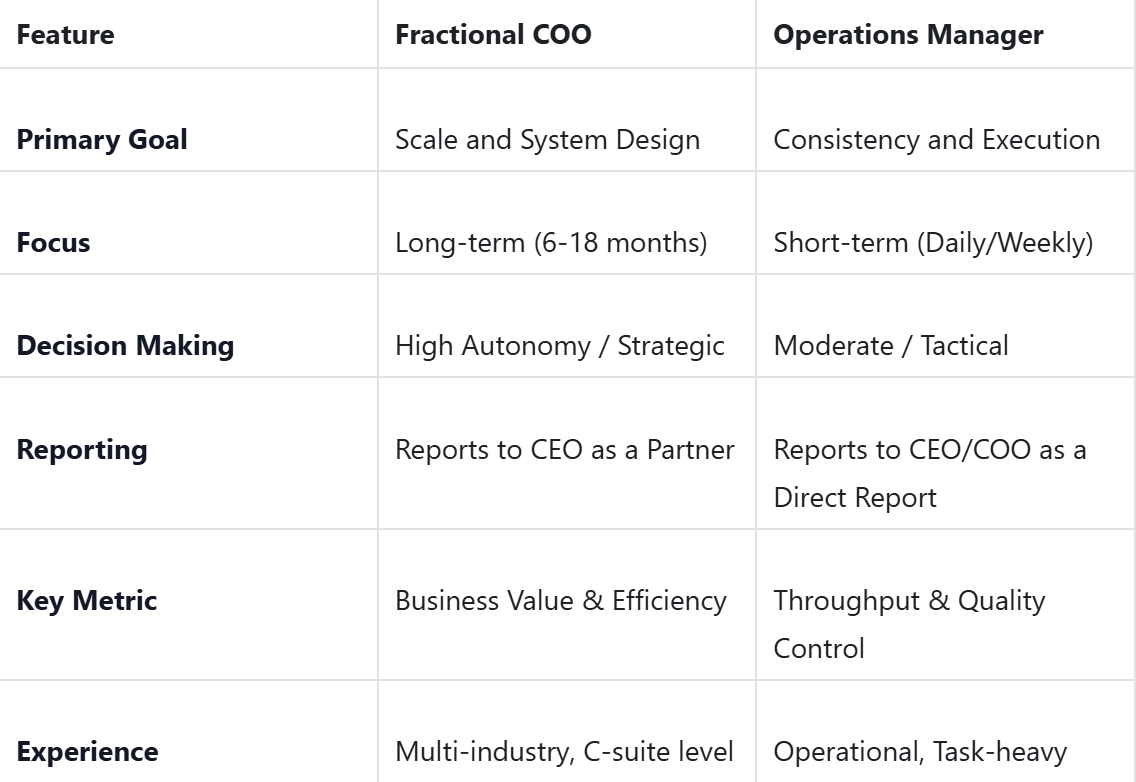

Action Items for Choosing the Right Role
To decide which direction to take, perform a quick audit of your current business state.
Analyze your "Daily Friction": Are you frustrated because the work isn't getting done, or because you don't know what work should be prioritized next? (Frustrated by "what" = COO; frustrated by "done" = OM).
Review your Decision-Making process: Use our guide on the decision-making process to see where the gaps lie in your leadership.
Evaluate your Budget: A Fractional COO is an investment in future growth (ROI-focused), while an Operations Manager is an overhead expense for stability (Cost-focused).
Audit your Systems: Do you have documented processes? If no, you need a COO to build them. If yes, you need an OM to run them. Check out our Tools and Checklists to see where your documentation stands.
Identify your Growth Goals: If you plan to double your revenue in 12 months, your current operations will likely break. A COO prevents that break.
The Case for "The Hybrid Approach"

Many established entrepreneurs find that they actually need both, but not at the same time. The most successful scaling strategy often looks like this:
Phase 1: Bring in a Fractional COO for 3–6 months. Their job is to perform a deep dive into your business, clean up the messy systems, and hire the right people.
Phase 2: The Fractional COO helps you hire and train an Operations Manager.
Phase 3: The Fractional COO stays on for a few hours a month to provide high-level mentorship to the OM and strategic advice to the CEO, while the OM handles the day-to-day.
This approach ensures you don't hire an Operations Manager into a chaotic environment where they are destined to fail. For more on managing your business during transitions, read our post on things you can work on during shifts.
Signs You Are Ready for Fractional COO Services
The "Founder Trap": Every decision, no matter how small, has to go through you.
Plateaued Revenue: You’ve been stuck at the same revenue mark for over a year despite working harder.
Team Churn: You are losing good employees because they lack clear direction or a defined culture.
Lack of Clarity: You aren't sure which of your service offerings is actually the most profitable.
System Sprawl: You have 15 different apps and none of them talk to each other.
If these signs resonate, you need business systems and processes consulting to restructure your foundation.
Signs You Are Ready for an Operations Manager
Balls are Dropping: You have great systems, but the team is simply forgetting to check the boxes.
Inbox Overload: Your team is constantly messaging you for simple "yes/no" answers on project status.
You Love Strategy: You enjoy the high-level planning, but you hate the "nitty-gritty" of project management.
Scaling is Happening: You are growing so fast that you can't keep up with the administrative burden of onboarding new clients.
Final Verdict: Which Is Better?

There is no "better" role: only the "right" role for your current needs.
Choose a Fractional COO if you feel like you are driving a car with a broken engine. They will fix the engine so you can actually go somewhere.
Choose an Operations Manager if you have a great car but you’re too tired to keep your eyes on the road. They will take the wheel so you can take a nap (or a vacation).
If you are still unsure where you fit, it might be time for a professional assessment. We help entrepreneurs find clarity in their leadership roles every day.
Next Steps:
Review your current team structure.
Identify your #1 operational bottleneck.
Contact us to discuss how a Fractional COO approach can revolutionize your business.
Check out more resources for managing your customers and operations.
Stop being the employee of your own company. Start being the owner.